The huntsman spider is present in practically all warm temperate to tropical regions of the world, including much of the United States. They are most often discovered living under rocks and tree bark, as well as in sheds, garages and other quiet environments. Larger members of this spider species are sometimes called wood spiders, because of their preference for woody places, like forests, mines shafts, woodpiles, wooden out-buildings.
Although huntsman spiders have been known to occaisionally inflict defensive bites on people, they are not widely regarded as a pest control problem, or seen as a danger to healthy humans. In fact, because they provide free insect control for homeowners and gardeners when they feed on a variety of insect pests, many people consider them to be a beneficial insect.
Learn more about the Huntsman spider.
Showing posts with label spiders. Show all posts
Showing posts with label spiders. Show all posts
Sunday, November 20, 2011

Camel spiders
The camel spider is a large species of spider, that can grow up to a foot in length (including their legs). This frightening looking spider generally inhabits warm and arid habitats, including virtually all warm deserts and scrub-lands on all continents; with the exception of Antarctica and Australia. Camel spiders have also been known to inhabit grasslands or forests.
Although their appearance may say something to the contrary, the greatest threat these spiders pose to people, is a defensive bite which it may inflict; if handled improperly. Thankfully, the wound that results is not life-threatening and there is little or no chance of death, directly caused by a camel spider bite.
Other than their shocking appearance and defensive bite, camel spiders do not have venom, they do not spin webs and generally do not require advanced pest control strategies; to eliminate.
Learn more about the Camel spider.
Although their appearance may say something to the contrary, the greatest threat these spiders pose to people, is a defensive bite which it may inflict; if handled improperly. Thankfully, the wound that results is not life-threatening and there is little or no chance of death, directly caused by a camel spider bite.
Other than their shocking appearance and defensive bite, camel spiders do not have venom, they do not spin webs and generally do not require advanced pest control strategies; to eliminate.
Learn more about the Camel spider.
Wednesday, September 7, 2011
Jumping Spiders
Although most commonly discovered in Tropical forests, Jumping spiders are also found in temperate forests, scrub lands, deserts, intertidal zones, and mountains.
Jumping spiders are active hunters and an effective natural exterminator of some insect pests. Remarkably though, this spider species does not rely on a web to catch prey. Instead, Jumping spiders stalk their victims. Utilizing superior eyesight to distinguish and track intended prey, they quickly attack, leaving insects little time to react; before succumbing to their venom.
According to bug and insect control experts, this spider's incredible speed is the result of a well-developed internal hydraulic system, which extends their limbs by altering the pressure of body fluid. This enables them to jump (up to) forty times the length of their own body. As well, when leaping from destination to destination, the Jumping spider will secure itself with a silk tether; to prevent a fall.
Read more about the Jumping spider.
Jumping spiders are active hunters and an effective natural exterminator of some insect pests. Remarkably though, this spider species does not rely on a web to catch prey. Instead, Jumping spiders stalk their victims. Utilizing superior eyesight to distinguish and track intended prey, they quickly attack, leaving insects little time to react; before succumbing to their venom.
According to bug and insect control experts, this spider's incredible speed is the result of a well-developed internal hydraulic system, which extends their limbs by altering the pressure of body fluid. This enables them to jump (up to) forty times the length of their own body. As well, when leaping from destination to destination, the Jumping spider will secure itself with a silk tether; to prevent a fall.
Read more about the Jumping spider.
Wednesday, March 30, 2011
Harvestmen
Harvestmen, more commonly known as "Daddy Long Legs", are not true spiders; but are very close relatives. Furthermore, Harvestmen do not bite or sting, they do not possess venom, and they do not create silk for webs.
Often discovered in large numbers around structures and inside buildings, Harvestmen are nocturnal hunters, that can offer excellent pest control services; against common garden pests.
Often discovered in large numbers around structures and inside buildings, Harvestmen are nocturnal hunters, that can offer excellent pest control services; against common garden pests.
Tuesday, March 29, 2011
Cellar spider
Cellar spiders can easily be identified by their extraordinarily long and thin legs (approximately two inches long), which are attached to an elongated body. Because of it's appearance, this spider pest is sometimes mistakenly referred to as a "Daddy Long-Legs", however that title has already been reserved for another species, known as the Harvestman.
Cellar spiders are fond of dark and damp areas, such as crawl spaces, basements, and sheds, but can also be discovered around doorways; and in garages. Like all spiders, this invader is a predator and carnivore, making them an efficient provider of natural pest control services against common pests; like moths, mosquitoes, flies and beetles.
Read more about Cellar spiders.
Cellar spiders are fond of dark and damp areas, such as crawl spaces, basements, and sheds, but can also be discovered around doorways; and in garages. Like all spiders, this invader is a predator and carnivore, making them an efficient provider of natural pest control services against common pests; like moths, mosquitoes, flies and beetles.
Read more about Cellar spiders.
Thursday, March 24, 2011
House spider
The House spider, also commonly known as the Hobo spider, is highly aggressive and notorious for biting humans; with little or no provocation.
Some experts say that this species' aggressiveness, is likely attributed to the House spider's poor eyesight. This handicap encourages the House spider to quickly attack anything, that disturbs their web.
Very common in the U.S. Pacific Northwest, the House spider is the most likely species to create pest control problems, by attacking and biting unsuspecting residents.
Read more about House or Hobo spiders.
Some experts say that this species' aggressiveness, is likely attributed to the House spider's poor eyesight. This handicap encourages the House spider to quickly attack anything, that disturbs their web.
Very common in the U.S. Pacific Northwest, the House spider is the most likely species to create pest control problems, by attacking and biting unsuspecting residents.
Read more about House or Hobo spiders.
Wednesday, October 6, 2010
Brown Recluse Spider

Recent studies at the University of Kansas, have shown that the Brown Recluse spider is largely a scavenger; preferring dead insects. It generally occupies dark, undisturbed places, and has been discovered by exterminators; both inside and outside of homes. In favorable environments, the Brown Recluse's population; is usually quite large.
Read more about the Brown Recluse spider.
Friday, October 1, 2010
The Wolf Spider
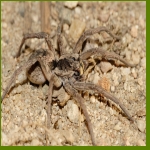
Although very much a recluse, many experienced exterminators will advise, that the Wolf Spider may inject venom; if continually provoked. Symptoms of a Wolf Spider bite are often minor, and restricted to local pain or itchiness. However, serious symptoms can include swelling, prolonged pain, dizziness, rapid pulse and nausea. In the event that symptoms persist, it is strongly recommended that you seek medical attention.
Learn more about the Wolf spider.
Wednesday, September 29, 2010
Southern Black Widow Spider

In most cases, the Southern Black Widow spider exhibits quite timid behavior. Even when disturbed, it will attempt to escape; rather than attack. Nevertheless, professional exterminators have strongly advised, that you exercise extreme caution when confronted by this pest problem; as the venom from an adult Black Widow spider is highly virulent.
Important to note: local pest control in the region has experienced varying sizes; within different geographical locations. For example, The species in Texas can be separated to some degree, by the shape of the red markings on the abdomen; and the location.
Learn more about the Black Widow spider.
Subscribe to:
Posts (Atom)